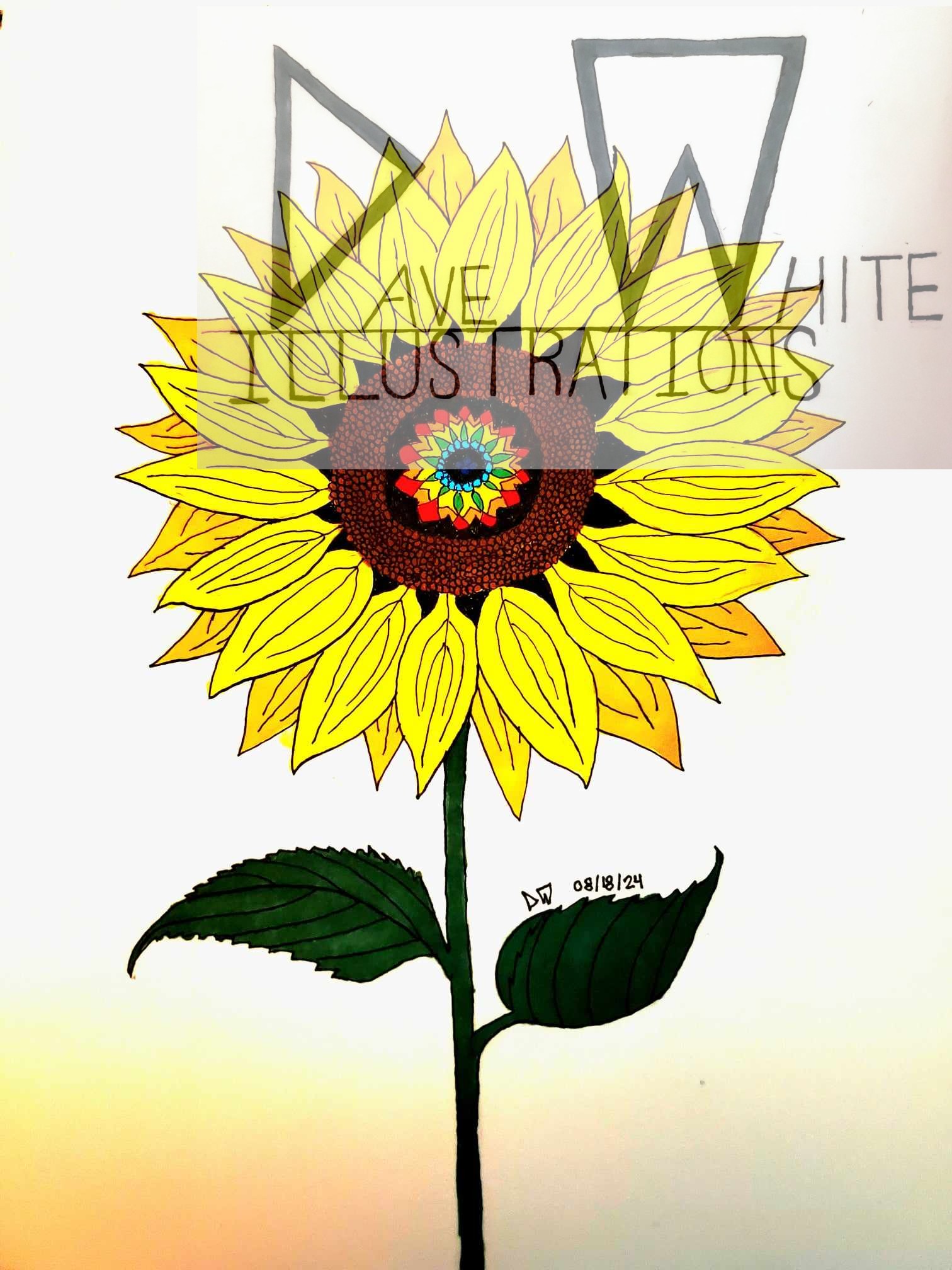
At the core of Poetic Bipolar Mind’s Emotive Fusion Art philosophy is a profound belief. It holds that some emotions can’t exist fully in one medium. This belief suggests that they need both image and language. Color and cadence are essential to hold these emotions with the care they deserve. Psychedelic Sunflower by Dave White and the poem If Fate Were Kinder exist precisely in that shared space. They reflect on a love that did not fail. It simply arrived at the wrong moment, in the wrong alignment, and in the wrong universe.
The sunflower has long symbolized devotion. Its instinct to follow the sun mirrors the human instinct to reach toward love, warmth, and connection. In Psychedelic Sunflower, this symbol is transformed. The familiar flower bursts outward in radiant yellow petals. However, its center fractures into a hypnotic mandala of color and motion. What should be solid becomes infinite. What should be grounded becomes a portal.
This visual distortion mirrors the emotional state of longing itself.
At the sunflower’s core, reality loosens. The swirling patterns pulse with intensity, evoking a love that lives vividly in the imagination—replayed, revised, and re-felt in endless variations. It is a love unconsummated yet deeply inhabited, one that exists more powerfully in thought than it ever could have in form.
The poem If Fate Were Kinder speaks from within that altered center. Its voice is not angry, nor accusatory. Instead, it speaks softly, almost tenderly, as if afraid to disturb the fragile world it imagines. The repetition of if becomes both prayer and ache. The speaker envisions intimacy not as fantasy, but as inevitability—something that should have happened, something that made sense, something the universe quietly refused.
What makes this pairing so devastating is its restraint. The poem does not rage against destiny. The illustration does not depict collapse or decay. Both choose beauty. Both choose reverence. Together, they suggest that some loves are not tragic because they end—but because they never begin.
The sunflower’s green stem and leaves anchor it in the physical world, reminding us that life continues. We grow. We move. We endure. Yet its psychedelic core refuses closure. Like the poem’s speaker, it lingers in possibility—what might have been if timing had aligned, if fear had loosened its grip, if fate had bent just slightly in a kinder direction.
This is not a story of heartbreak in the conventional sense. There is no villain, no betrayal, no dramatic rupture. Instead, there is acceptance laced with grief—the understanding that love can be real even without touch, even without shared history, even without a future.
Psychedelic Sunflower and If Fate Were Kinder honor a truth many carry silently:
that some connections shape us without ever becoming tangible.
That longing itself can be formative.
That love does not require fulfillment to leave a permanent mark.
In this Emotive Fusion Art pairing, beauty does not resolve pain—it coexists with it. The sunflower continues to bloom, radiant and alive, while its center remains forever altered by what it holds. And perhaps that is the quiet lesson offered here: that we do not outgrow longing—we learn how to live beside it.
Some loves exist only in the imagination.
Some blooms open in the wrong timeline.
And still—they are beautiful.
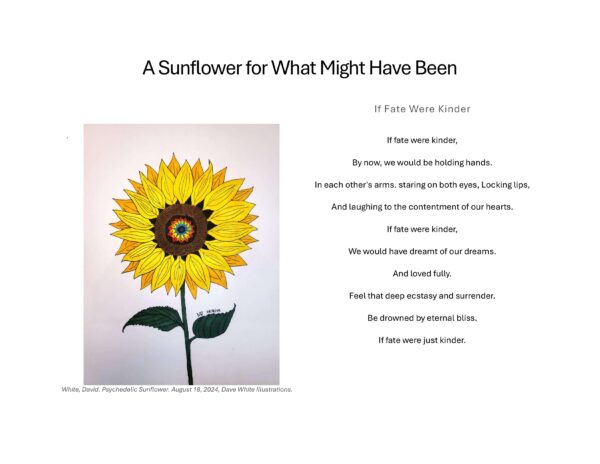
A Sunflower for What Might Have Been
A digital download pairing Dave White’s Psychedelic Sunflower with Kiana Jimenez’s poem “If Fate Were Kinder,” exploring love restrained by circumstance and the beauty of what might have been.
25 in stock


Leave a Reply